Market Value
Market Value: What Sustains Us
Thursday 16 and Saturday 18 July 2026
at the South Molton Pannier Market
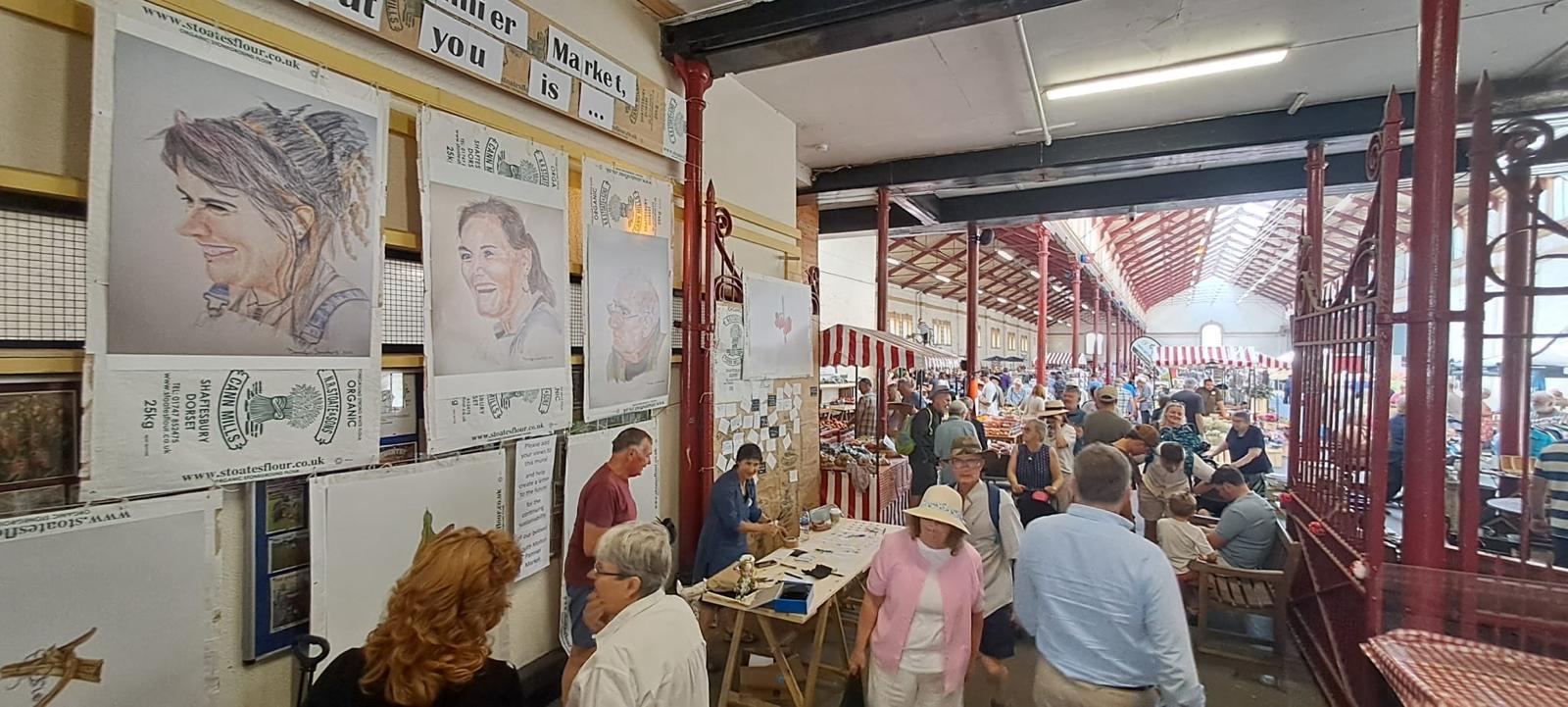
… is my Final Major Project for my MA in Fine Art (online) at Falmouth University. In this exhibition I investigate how paintings of portraits and botanicals can operate as a stimulus to understanding the nature of the South Molton Pannier Market. I also question how the work can attend to the sustainable future of the Market through conversations with traders that illuminate their histories, motivations, rituals, and ways of working, conversations with those who come to buy their produce, and through a collaborative mural which gathers these ideas together.
The South Molton Pannier Market is distinctive in that it is more than the goods it sells. It rests on the personalities of the people who run the stalls, offering value not just in what is being sold directly from maker to shopper, but through social engagement, care, and emotional sustainability. This exhibition celebrates the South Molton Pannier Market as a location where the identity of people and place is celebrated and valued.
Click the images to see in full resolution.
This video offer an insight into Luna kneading the dough at her bakery and preparing for Market day (duration 1:49).
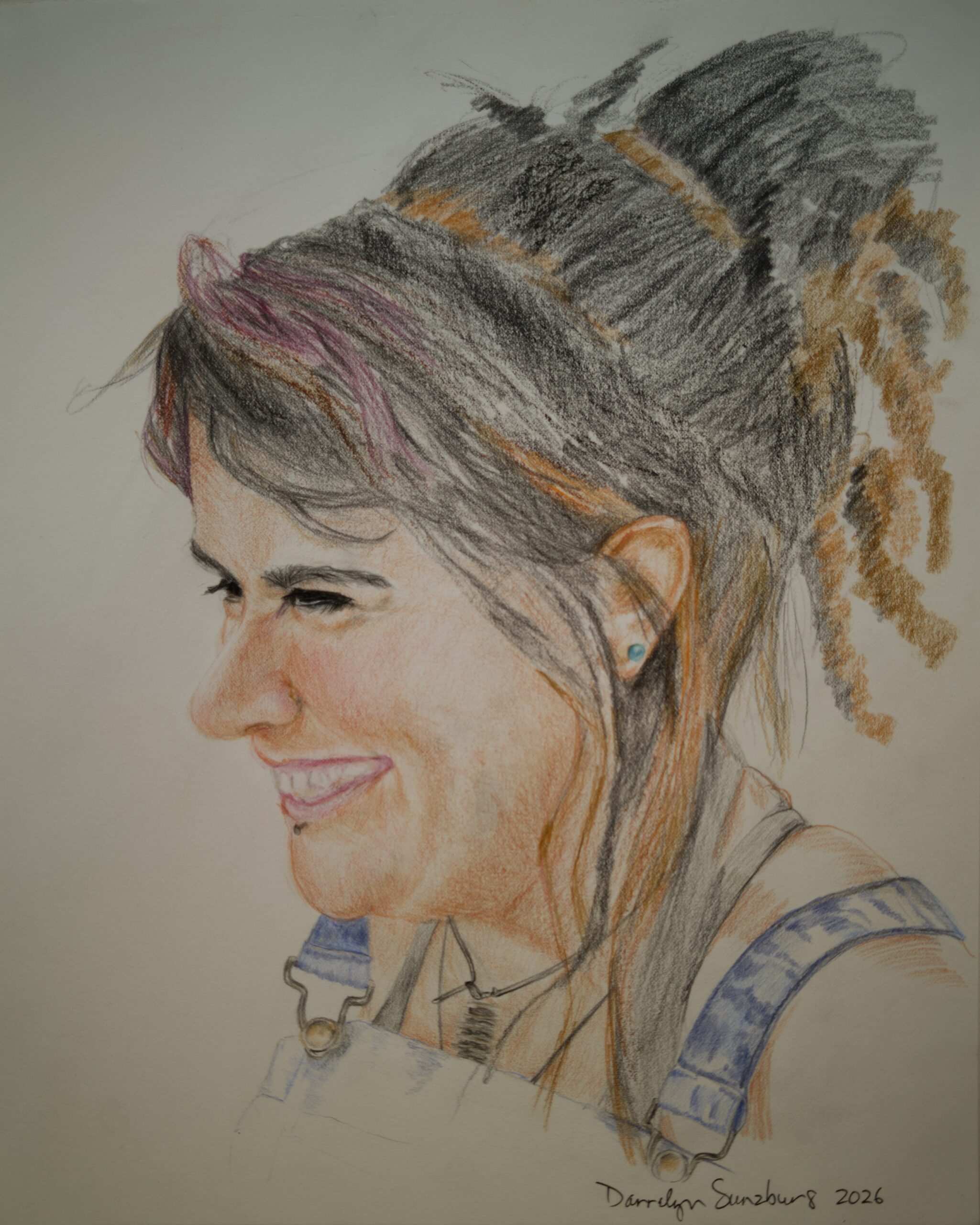
Luna Recena Dios, 2026, colour pencil and pigment, Strathmore Bristol Vellum paper, 27.9 cm x 35.6 cm.
Luna Recena Dios
Lucho Bakes
‘Baker by accident,
literally’
I’m a baker by accident, quite literally. When we opened the unit in April 2023 I was just helping Lucho by washing boxes and learning a little about how to make bread, but I was mainly supporting and making a few things here and there when Lucho had an accident and nearly chopped off a finger and I had to take control of the production during his recovery and I have carried on ever since. Now me and Meg, make the bread, Andreia the pastries, and Lucho bakes and runs the admin and logistics of everything, keeping the business machine running.
I was born in Cordoba and moved to the UK in June 2015. As much as I love where I’m from and miss my family, here is home. It is where we could learn a new profession when we moved here, and where we could make the dream of having a very successful business with our incredible staff, Meg and Andreia, come true. Here people really value our products and our efforts of using local products and working with local farmers.
Before landing in the South Molton Pannier Market we used to do many markets and festivals around Devon and Somerset. It was good, but we had to work much harder and travel many miles to show our products to new people every time. Since we established ourselves in the South Molton Pannier Market we have a very loyal customer base that come weekly (many of them daily!) to get their favourite products and I know them all and what they like and we have forged a very tight relationship with the community. Having regular customers on a regular basis is really important for us because we can control the quality of our products, gain direct feedback if something is not right, and get an immediate response from our customers when we launch and test new products.
We wouldn’t be what we are right now without the Market and the relationship we have with the other traders. We take care of each other and always help in the stalls around us whenever we are needed, making us a big family.
Recently we joined the South West Grain Network, which was established in 2019 following on from the first UK Grain Lab which was looking for ways to advance an alternative grain economy in the UK. The South West Grain Network’s manifesto is one we really resonate with: ‘to address the needs of bakers, millers, farmers and other grain users looking to build an alternative grain economy, one that is human scale, non-commodity and grounded in friendship and collaboration.’ We are incredibly excited to be active contributors to this community of grain users that nurtures and promotes ecological and social wellbeing.
More information on the South West Grain Market can be found at: https://www.southwestgrainnetwork.co.uk/
In this video of Stafford at his flower stall at the Market, he points out how the soil is a battery and needs replenishing (duration 00:18).
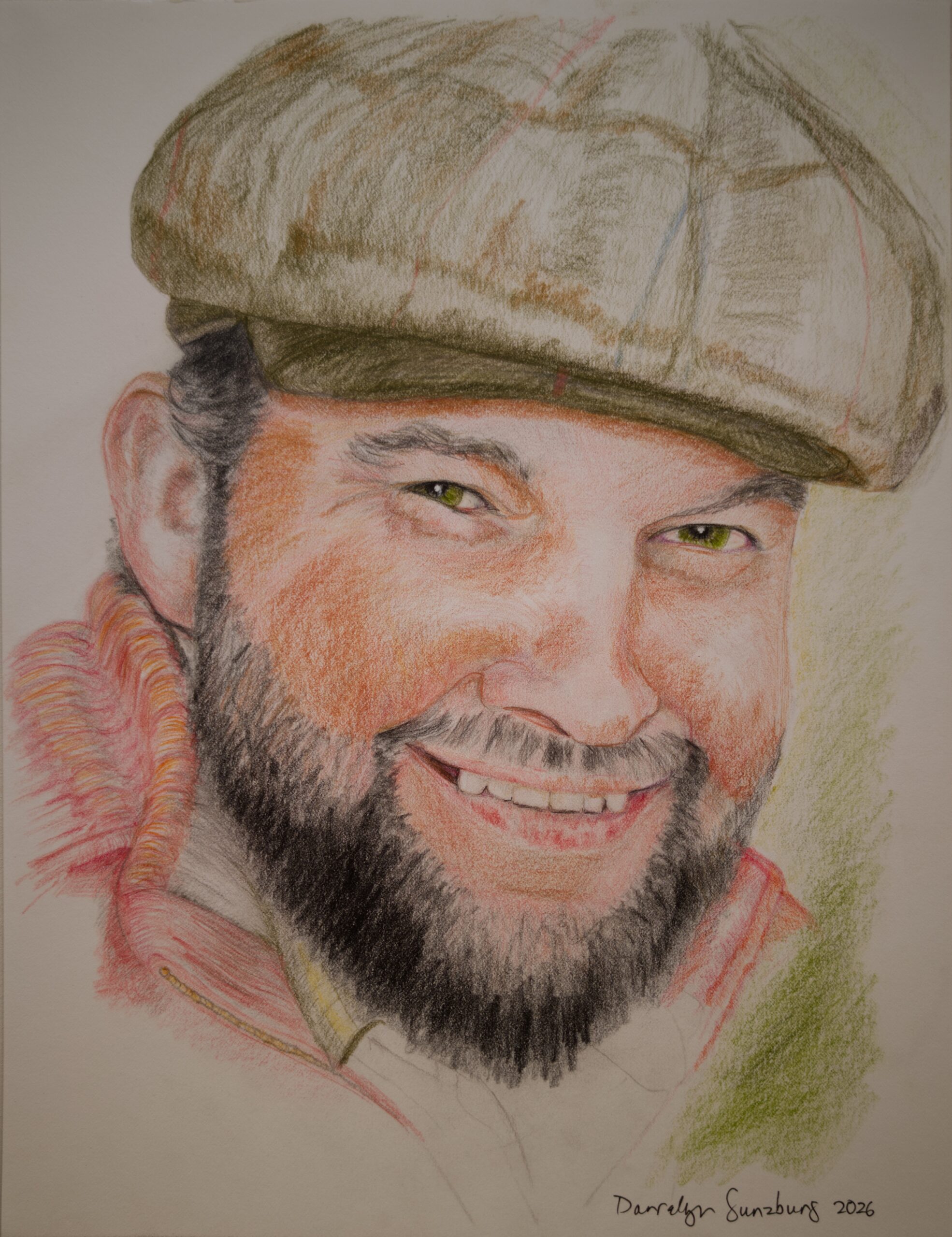
Stafford Curle, 2026, colour pencil and pigment, Strathmore Bristol Vellum paper, 27.9 cm x 35.6 cm.
Stafford Curle
Peamore Flora
‘My earliest memory is sleeping under
my father’s market stall
in big flower boxes ’
My parents were living in a caravan on two and a half acres, just outside Exeter and we lived in what used to be the market garden to the manor house across the road, so actually my Dad didn’t have enough land to farm. But there was some hybridised blackberries that were growing on the property and Dad used to pick those and take them to market and sell them. Then he started growing a few things and then he moved into potted plants, which is actually quite recent, and he started selling plants mainly at Barnstaple, but he had stalls all over Devon, Dartmouth, all over the place. Then he went into cut flowers when that started to be at South Molton and that’s an all year round thing, rather than just the seasonal plant sales.
I used to go to markets with Dad when I was about 4 or 5. My earliest memory is of sleeping under the stalls in big flower boxes. The flower boxes are about 5 foot long by about 2 feet deep, so I suppose it was a bit like being in a coffin, but it was quite cosy, really, just tucked in there. If I’m honest, I didn’t really know what I wanted to do when I was at school. When I was little, I always wanted to be a ‘sailor’ like my dad. ‘I want to sale things like my Dad!’ But I went into horticulture just because I was quite good at it, basically. When I was about 16, I went and worked in the bulb fields in Lincolnshire and I went on to Horticultural College in St Albans and learned how to grow things. After I graduated, I came back and worked for Mum and Dad, then worked for a nursery in Totness, mainly focused on bedding plants. Then I worked at a cut flower nursery in Somerset, which isn’t there anymore, which is a shame. Then I worked as a manager in one of the Lidls store but decided to go back into markets. I’ve been at the South Molton Pannier Market for about 17 years. When my grandparents died, I bought my house, which was their house, off my parents, and just trundled on from there, really. I just got to know people, other growers, and that sort of thing, and bought and sold. I don’t actually grow much now.
I used to do Barnstaple, Tiverton, Honiton, and then a couple of stalls in Exeter and then trends changed a little bit, and now I do wholesale flowers from Exeter, and flowers for weddings and funerals. I’ve got the stall here and a stall in Newton Abbot.
I’m happy selling flowers. I like the variety, and the seasonality of it. When you start to see things like daffodils, they’re like cherry blossom to the Japanese. It’s that new life, spring’s coming, it’s getting warm and there’s the joy and the bright colour and ‘hey, look at me’ sort of thing. It definitely energises you. And also just something unusual coming into the warehouse. It’s like, ‘oh, that’s different.’ And then the scientific side of it as well, ‘What is it? How did they cultivate that?’ and the whole history of their names and family groups and all the rest of it. It’s quite interesting. And then you’ve got people getting married and coming into the warehouse and wanting your advice about what to put in their bouquets, and it’s quite nice because most of them are worried about doing their own flowers and I tell them ‘Oh, it’s easy. Just do this, this, this, this, and you’re sorted.’ So it’s quite nice to have specialist knowledge, but also to be able to help people. You get such a mixture of people at the Market stall. You get, I don’t want to say blokes, but they come up with, ‘I’ve got a tenner. Just do me some flowers.’ And then you get the other ones, ‘Ooh, I’ll go with this.’ And then you’re like, ‘Well, I would go with the points on this’ or ‘oh, I want something that lasts a bit longer.’ ‘Well, go for this.’ ‘Oh, it’s boring.’ ‘Well, have this then.’ And it’s nice to have that knowledge to try and impart on people. Quite often, when customers come and choose their own flowers, they choose the colour they’re wearing, because obviously that’s their mood or a favourite colour. I find it quite interesting as you can offer them suggestions in their colour range.
In terms of being a market trader, I suppose the only thing I would emphasise is it’s always your money on the line, rather than a company. We’re not working for people. Customers are not obligated to buy, ever, but they are putting our food in our mouths, literally, by buying off us and it’s a very appreciated and personal transaction. People come and go, ‘Ooh, these might be cheaper somewhere else’ and I’m like, ‘yeah, but they’re a big company or a big conglomerate.’ And other people say, ‘Oh, I wish we had a market like this.’ If they don’t buy, we can’t afford to do it. So it’s getting the balance right between quality, price, and quantity all the time with people.
The other thing that I would add that the soil is a battery and you need to replenish all the things that the plants have taken out and recharge them. As much as the plants do quite a lot it’s good to put manure or fertilisers in to recharge the soil itself.
Part of the success of this market is that I know so many people. I’ve seen people born, I’ve seen people die, and it’s quite shocking, really, when people, unfortunately, go, and people want to buy the flowers for the funeral, and I can help. And then you get the others where they’ve been waddling through pregnant and then they’ve had twins and the twins are now 16, 17, you think, ‘Oh, that’s a bit long ago, you know, getting a bit old’.
In this video John introduces himself and the range of goods he sells at his Market book stall (duration 00:21).
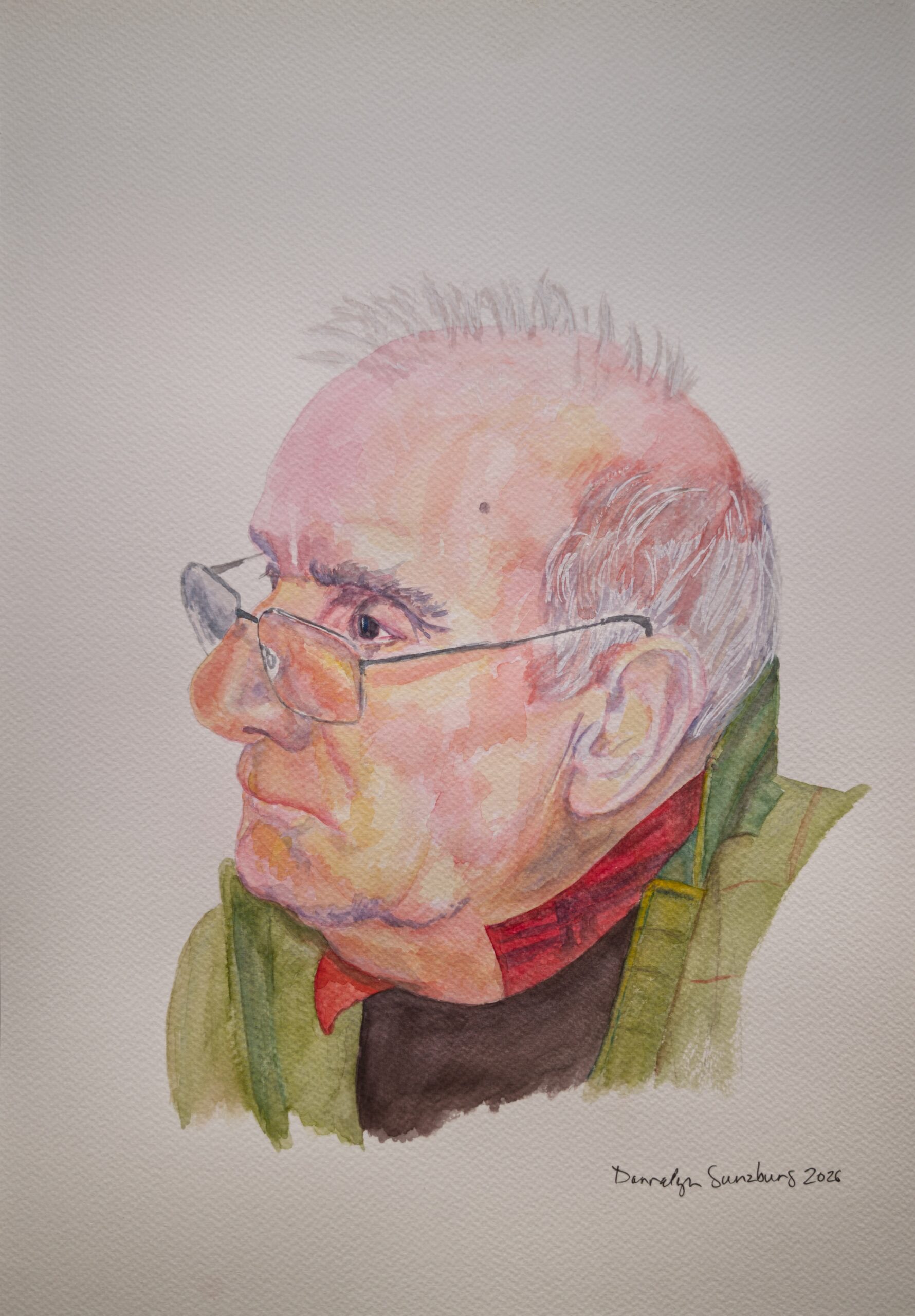
John Wilkinson 2026, watercolour, Fabriano paper, 300 gsm, 297 x 420 mm.
John Wilkinson
The Market Bookstall
“Books that are leather-bound,
hand stitched with a tooled spine and
marbled end papers can actually look like treasure.’’
I grew up in Minehead on the Somerset coast and I have very fond memories of childhood, and school, and art in school. I left Somerset when I was in my late teens to go to the Somerset College of Arts and Technology. Then I went to St Martin’s School of Art in Charing Cross Road, London, in the late 1970s to study Fine Art: Sculpture. I was very interested in the 3D sculpture at the time and it was the last time you could get a pure sculpture degree at St Martin’s. Now it is mixed with other things.
Deb, my partner, and I both did our degrees at the University of Lancaster. Lancaster is a tiny city, but with access to the Lake District and the Yorkshire Dales, to Scotland, to both coasts. It was just great. But when we finished we thought that we could either stay in Lancaster forever and make our lives there, or we could do something really, really different. We saw an advert in The Guardian that said, ‘Teachers wanted’ and we decided that we would go and teach English in Africa for a while. But every time we came back to the southwest to see family, whether from Yorkshire or Lancashire or Africa or France, it always felt like it was home. So we decided to come back here. Deb was teaching, she’s a primary school teacher, and one of my first jobs was with Dartington Crystal in a warehouse down by the river in Torrington where I worked for three years packing and doing warehouse management along with my own artwork. But each year at Dartington Crystal a very substantial number of people were made redundant, and I just saw it coming. In fact, in the first year that I worked there I was called in to the office and my manager said to me, ‘Look, I’m sorry, John, but you’re in the last-in-first-out kind of situation. We’re going to have to make you redundant.’ I said to him, ‘Well, I don’t want to go.’ And he said, ‘Oh, that’s interesting. Nobody’s said that.’ But redundancy was on the cards and while I clung on to my job, which I really liked, I decided that I needed another string to my bow or different aspects to rely on and so I started a market stall here. It was a mixture of things, but I knew a lady whose daughter was in Kenya and had set up a women’s knitting and textile cooperative in Kenya. It was absolutely and fundamentally fair trade, homespun, hand knitted, gorgeous things and I used to sell those. I loved that.
I also sold books on the bookstall. The way that happened was that Deb and I were collectors and if you’re a collector, you find over the years that you get duplicates in your collections, and then the duplicates pile up, and so you get boxes of duplicates. And people buy you things for Christmas that they don’t know you’ve already got and that piles up, too, and so my first stall was a bookstall of duplicates from our collection. That’s how it started. From then on, I’ve happily bought books. I buy second-hand books in all sorts of different place. People call me out to houses and all the family have taken the books they need and what’s left can be sold, so I’m a happy buyer. Sometimes second-hand books can be really expensive, particularly if it’s a rare signed first edition. But on the whole, they are fundamentally affordable and reused, recycled, and re-energised.
People expect me to be very anti-digital, and I’m not, although I have to qualify it and say that is becoming incredibly difficult with AI. As I see it digital is just another way of reading and I think reading is fantastically important, reading stories, getting information. Nothing replaces the actual physical object. Lots of people come to the store, particularly younger people who haven’t experienced antiquarian books a lot, and they pick something leather-bound, hand stitched with a tooled spine and marbled end papers, and they think, ‘Gosh, this is what books can actually be like. They can actually look like treasure.’ It’s a very, very tactile experience and there is something great, glorious, and traditional about the physicality of it. I’m not the kind of bookseller that only wants the collectors. I want as many people to be interested in books for as many different reasons as possible. I really like the idea of books being part of people’s lives, and books having another life and as many lives as possible. There are different ways of being with books. Some people buy a book, read it, take it to the charity shop, pass it onto a friend, and they’re not necessarily living in rooms surrounded by bookshelves full of books, but they are reading and they are enjoying books, and they’re talking about books, and they’re sharing ideas about authors and the storytelling all the time.
I’ve had stalls in lots of other markets in this area. Tiverton and Barnstaple and Tavistock, all on different days and different weeks. All the markets had their good days and bad days, poor weeks, and fantastic weeks. But when I put my accountant’s hat on, over a 12-month period, South Morton was always the market that did best for me. Not only did it do the best financially for me, but emotionally, too, because it is just always really lovely to be here. It’s lovely to be at work and to chat to people and say hi to people walking by, constantly, with their dogs, kids going to school holding hands with their mums and dads and their brothers and sisters and getting to know people over the years. Then there are the people that come in to the stall and say, ‘Oh, I’m looking for a present for my uncle who really likes stamps and trains. Have you got anything along those lines?’ Well, actually, I do. It’s just lovely when a buyer finishes her purchase with the sentence, ‘My daughter will be thrilled.’ That’s a nice part of anybody’s working day, isn’t it?
It does matter how much I make each week, but I don’t have targets because I’ve just learned over the years that it depends on footfall and it depends on people’s mood and also the general feelings about the current economic climate. And subject matter changes through the seasons or with the economic climate massively and I mean, massively. In the summer there’s holiday reading, and comics for kids in the caravan. Then throughout the winter there are different people coming to the store. It’s also so weather dependent. If it’s drizzly or inclement people are just a bit more reluctant to come out. If it’s sunny, then people will take the dog for a walk and come on through. But this is where I make my living. And I’ve always had a belief that if you’re not enjoying the way you make your living, then change it. Seriously. You’re in the wrong job. And I know that’s not always easy for people and it’s not always easy for me. I’m here very early in the morning, and I’m here in all weathers and all seasons. But South Molton Pannier Market and these environs are incredibly supportive of me. And I am very grateful for that support.
I’ve stopped doing those other markets. All of my eggs are in this amazing community basket. It’s unlike anywhere else I’ve been. I think we are incredibly lucky, because it’s an utterly unique retail environment which is singularly remarkable not just because of the variety of remarkable people in here but because we are situated within this interesting catchment area and surrounded by people who want to support the market, who choose to come here, and choose to spend some money with us. And it’s an incredibly organic situation. It is slightly different each week and you never know what you’re going to find. People will come into market for some vegetables, or a hand stitched baby grow, or some olives, or a pebble picture, and they see a picture of Exmoor that they can’t resist, or a book that they haven’t seen for 40 years.
I feel that people want me here, they want a bookstall in the market. They want the mixture of things that I’ve got on the stall, so I feel that my job is worthwhile. I’m also an artist, I make two- and three-dimensional artwork and I had a really lovely exhibition with Beaford Arts at The Plough and other venues, which was great. It was good to come back to the West Country and find that somebody was interested in my artwork which is very landscape energy led. It’s led by the wind and light and the birds, and the geology of the landscape, the shape of it and the changing perspective, the changing light, I love all that. And having a book stall means that I can have my own artwork here as well on the stall, which I often do.
I write as well, and my book, The Barrow Ship, was published by Ollie Tooley, Blue Poppy Publishing , who also has a stall in market. He’s a fantastic guy who’s an absolute powerhouse in terms of publishing and enabling in this area. We’re very lucky to have him. The Barrow Ship is mythical-realist fiction which took me eight years to write. I had an eight year long love affair with the process. I am currently writing another book. I’m constantly pushed by my creativity. In an ideal world I would make more time to get out on the moors and do more drawing. But I feel this is a really good place for me to be.
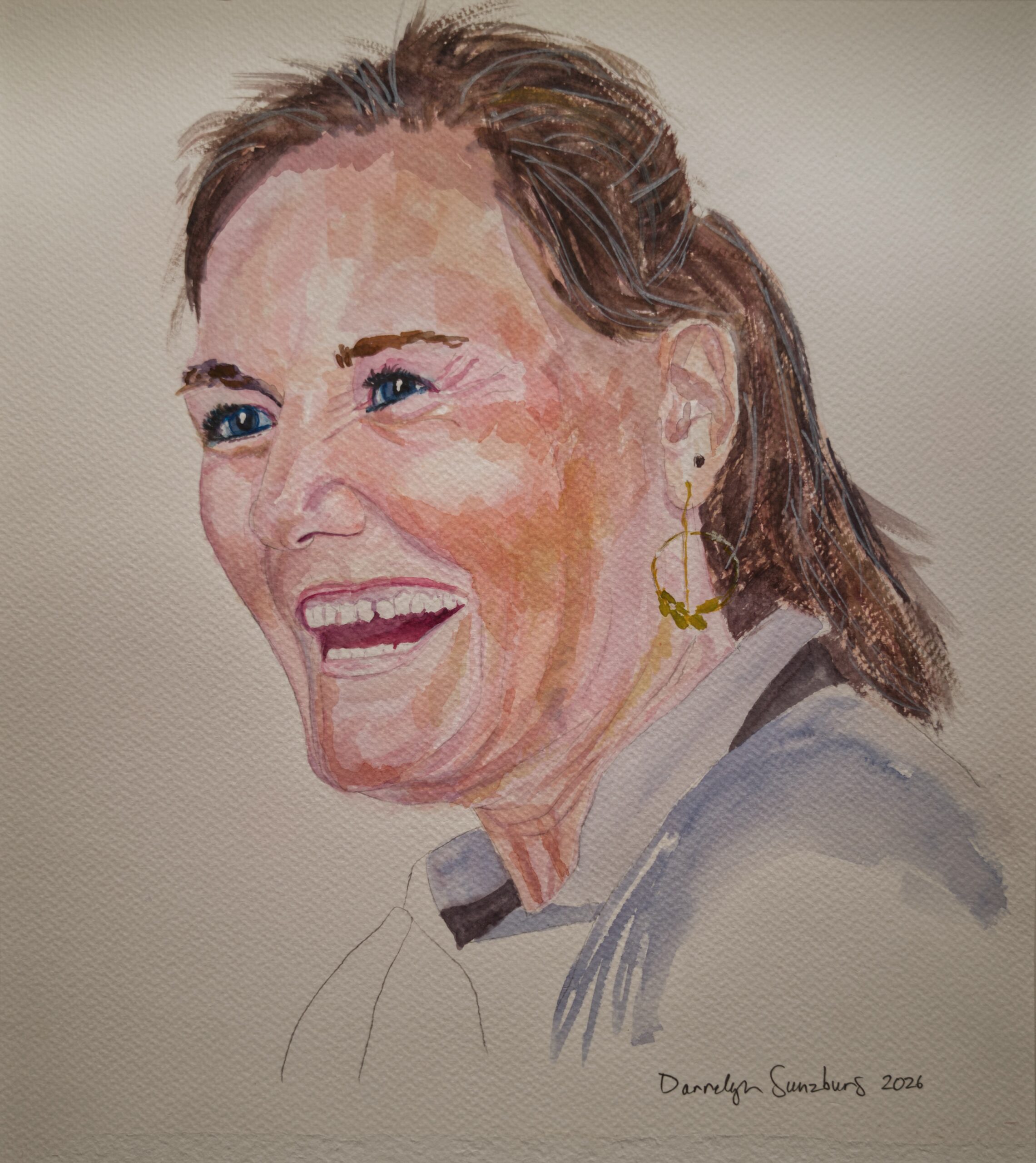
In this video Megan describes the role the Market has played in helping her to grow as a person and a businesswoman and how much she values the supportive networks around her (duration 00:55).
Megan Garrod, 2026, watercolour, Fabriano paper, 300 gsm, 297 x 420 mm.
Megan Garrod
Olives Plus
‘The market is
my happy place.
It’s like a little family.’
But first I went to university and got my degree in geography because I wanted to go in the Air Force. I wanted to be a pilot. I was obsessed. I even went to sign up and everything, because I thought I could go in as an officer. And then that just didn’t happen, because I ended up staying here, and met my husband and was like, ‘What do I want to do?’ I worked in insurance and hated it with a passion. And then about 10 years ago the opportunity came up to take this on. So I thought, ‘Right, well let’s do it.’ So I set up a dried fruit stall after Uni and alongside insurance. Obviously, I couldn’t take it all on when I did this, so I chose the bestselling product from the dried fruit stall, mango, dried peaches, dates. When I took over I changed it a lot. I changed supplier and also the market management moved us all around. We all faced into each other but this is a much better orientation. I do Hartland once a month and food festivals here. I also do online and wholesale as well and catering.
I didn’t have any business training. Over time, I’ve just developed business skills. I ‘ve learnt by being in the field, learning on the job. My dad’s always been self-employed, and he’s always been very savvy with money, and he always said, ‘You’ve got to stand on your own two feet, and try it, if it doesn’t work you’re only the one to blame.’ So then I worked with Celia, who ran this stall and then I did my own dried fruit stall and learned the hard way, I suppose, because you just learn these things, don’t you, how much you’ve got order, where’s your money coming from, things like that. And you’ve got to have a certain type of personality to be able to do this work. You’ve got to be quite friendly and outgoing and hardworking. Very hard-working and put the hours in. It’s good. I’ve always been very sociable. I like people.
What do I love about the market? I feel like it’s my little happy place. The market is like a little family. I love it here. I’ve got some really, really good friends from being here. My market Mum and market Gran, we’re like a little family. Market Mum is Ali on the cheese stall and Market Gran is Lynn on the fudge stall. We’re just really close and been working together for years, so I just feel really comfortable and happy being here.
The other traders are really supportive. They talk to you, and they check on you, and every time you’re in the market, if you’re a bit down, they rush over with a cake or a coffee. Everyone’s out for each other. If someone’s not very well, everyone mucks in to help them out. It’s like a team more than anything.
And the management of the South Pannier Market is really good. Everyone’s got respect for each other. We’ve got respect for them, and they’ve got respect for us. They come round and ask how we are and it makes a difference. This carried over from the previous management of Mel and Will. Mel was a market trader and both of them were here all the time, chatting to us and getting us all involved with each other, asking us questions. We’d have little meetings and we’d have a Christmas do and every market they helped us to be more of a community. The current manager, Adam Nichols, used to be a trader here years ago doing magazines, and he’s amazing. He runs his own business, so he knows what he’s doing. It’s a really good feeling amongst us all.
Would I do anything else? No. No, nothing else. I don’t think anything would make me as happy as this. And I could never, ever work for anybody else. I’ve worked for myself for far too long now, to be able to be told what to do. I couldn’t – no. No way. I like to do what I do. And if it’s gone wrong, it’s my fault. Definitely never work for anyone else. So it’s this or nothing for me.
Get in touch
If you would like to speak to me about any of the publications or work on this website please send me a message using the form below.
You can also contact me on Facebook.
Enquiry form
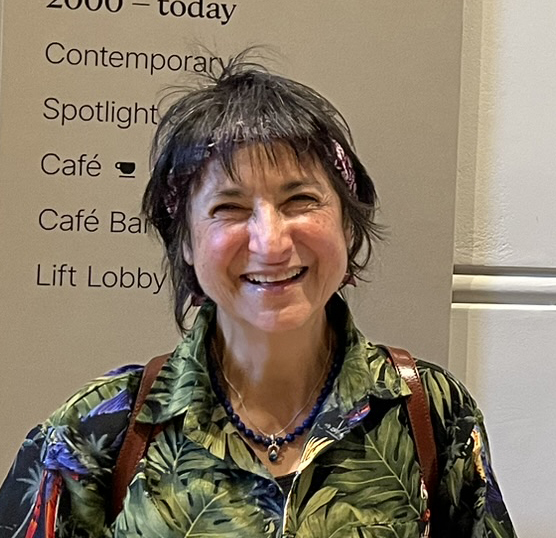
Darrelyn Gunzburg at the National Portrait Gallery 2024